
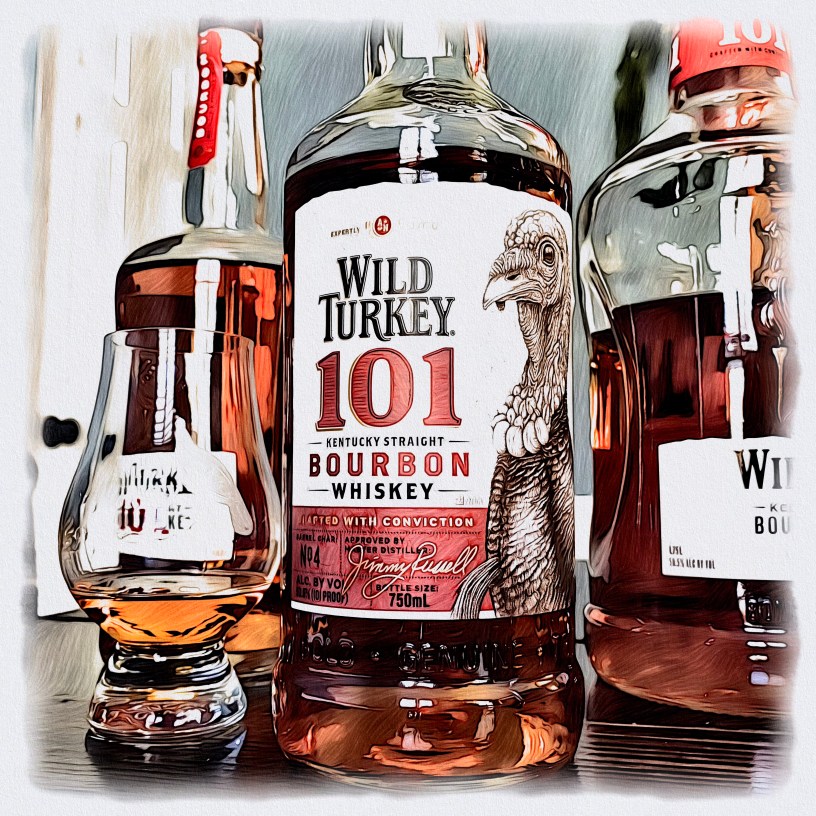
I have three individuals to thank for today’s post. First, a reader named James T., who wrote to me asking if I’d review a recent bottle of Wild Turkey 101. Second, Kurt and Trenton from the YouTube channel SLB Drinks, who recently posted a video titled, “What’s Wrong with 101?” Long story short, there are some who believe that Wild Turkey 101 isn’t the bourbon it used to be, whether for the better or worse. I’m not talking about dusty Turkey versus modern Turkey. I’m talking about the same Wild Turkey 101 that’s been on shelves for the last 10 years or less.
I’ll be the first to admit that Wild Turkey 101 is “batchy.” I hate to use the word inconsistent as it infers a quality dip, which isn’t always the case. When it comes to whiskey, a difference in profile – even among bottles of the same label – isn’t necessarily a bad thing. This is especially true for single barrels and extremely small batches where uniqueness is arguably a desirable thing. But when it comes to flagship expressions of a considerable volume consistency is often preferred. Whether it’s Maker’s Mark, Jim Beam White Label, or Wild Turkey 101, consumers have expectations. Stray too far too quickly and you’re likely to lose loyal customers.
But inconsistency, or “batchiness” (okay, now it’s sounding silly), isn’t a modern problem, nor is it a Wild Turkey problem. It exists for all whiskey brands to some degree. With Mother Nature playing a large role in bourbon’s flavor, flawless consistency from year to year, batch to batch is damn near impossible – especially for producers aging their whiskey in traditional wood/clad rickhouses, such as Wild Turkey. Even highly sought after dusty releases from the fabled Glut Era vary in profile. While many vintage bourbons are excellent, some are simply better than others.
All of that being said, I’ll confirm that today’s Wild Turkey 101 doesn’t taste like yesterday’s 101, and by yesterday I mean just a few years ago. It doesn’t take a finely tuned palate to realize it. Just compare a current bottling of 101 with a mid-2010’s bottling side by side and it’s pretty obvious. But when did this shift take place? Was it slow or sudden? And, more importantly, why is it happening at all?
Today’s post will attempt to address these questions. I’ll start with a blind tasting of four Wild Turkey 101 releases, each two years apart chronologically: 2018, 2020, 2022, and 2024. I’ll then take my results and try my best to shed some light. Expect a hefty dose of speculation, however. I’ve picked up some insights into Wild Turkey’s process over the years, but I’m no Russell. Only Jimmy, Eddie, Bruce, and their distillery team have the knowledge and experience to explain this phenomenon with any real authority.
Proof
I arranged my tasting with four lookalike Glencairn glasses, each containing 1.5oz of Wild Turkey 101 from the years listed above. The glasses were labeled under their bases with their relative years, then carefully shuffled and given a little air time. After a brief rest, the glasses were reshuffled and labeled on the sides as A, B, C, and D.
Color: The color for all four whiskeys are virtually the same. Any differences are negligible.
Nose: Glasses A and B are very similar, showcasing traditional bourbon notes in a warm and inviting way – caramel, vanilla, charred oak, and baking spice. Glasses C and D are also similar, though notably different than A and B. With C and D, notes like pear, crisp oak, cinnamon candy, and dried citrus leap from the glass. C and D are also more cereal/corn-forward. One might even call them a pinch “grainy.”
Taste: The taste of both A and B exceeds what one might expect in a $25 Kentucky straight bourbon – rich vanilla, brown sugar, oak spice, and hints of cola and clove. Unfortunately, C and D fail to follow suit, and while acceptable for an affordable whiskey, sweet corn, white fruit, vanilla icing, and cinnamon constitute 95% of the experience. Of course, taste is subjective and one might prefer the taste of C and D over A and B, it’s just not my preference.
Finish: While each of these whiskeys have what I’d describe as a medium-long to long finish, true to the pattern established by the nose and taste, A and B stand a notable distance from C and D. A and B again hold tightly to the traditional bourbon notes (caramel, oak, spice) with the addition of some cherry, orange, and baked cinnamon (not to be confused with cinnamon candy). C and D, on the other hand, feature more cake frosting, white pepper, bright oak, and, you guessed it, cinnamon candy. I’m not getting as much grain on the finish as I do the nose and palate, but that may be because the initial blow has diminished.

Summary: It was fairly easy deciding my order of appreciation: B, A, C, then D. I’ll stress that the divide between the two pairs (A-B, C-D) is rather significant. If this were a double blind, I might assume they were completely different brands or expressions. As for what they turned out to be, they just happened to land in chronological order: 2018, 2020, 2022, then 2024. Prior to this tasting I was certain 2024 was an improvement over 2022. I also thought the 2018 Wild Turkey 101 (LL/GH) would place well above the 2020. It placed on top, but only by a fraction. Reviewing my notes, I preferred the nose and finish of B (2018) but the taste of A (2020). I think there’s something to be said there which I’ll touch on later.
As for C and D, what can I say? They taste like $25 whiskey, but nothing to write home about. I suppose this only illustrates why I’ve purchased less 101 over the past few years, gravitating more towards Kentucky Spirit, Russell’s Reserve Single Barrel, and Rare Breed. Unfortunately, those expressions are over two to three times the expense of Wild Turkey 101.
Decode
With a profile shift firmly established, I’ll jump back to the questions I introduced earlier in this post: When did the profile shift take place? Was the change slow or sudden? And, why has it changed at all?
Based on the tasting notes above and the fact the 2020 example was bottled on November 20th and the 2022 version on May 10th, it appears that Wild Turkey 101’s profile shift happened sometime in 2021 or early 2022. I’d consider that a sudden change. Sure, it likely took a few months to fully transition to the profile we have now (my review of a June 2021 bottling supports this notion), but a year is a very short timespan in the grand scheme of things – especially whiskey. Which leaves us with one last question: Why?
It’s purely speculation, but I think it’s as simple as money. As much as folks would like to believe the profile shift is a result of the new still (2010-2011) or some change in which rickhouses are used for aging barrels for 101, I think it’s simpler than that. There is a finite amount of bourbon Wild Turkey can produce in a year. Until the second still becomes operational that volume won’t change. Even when the second still is operational it will be years before that whiskey is sufficiently aged. At the rate Wild Turkey is cranking out limited editions (we saw four this year), not to mention a noteworthy increase in the number of private barrels and brand extensions, that leaves a lot less well-aged and/or choice barrels allocated for core expressions like Wild Turkey 101.
There is some good news, however. A COLA filing for Wild Turkey 101 8-Year was recently approved by the TTB. The last time the U.S. saw a regularly produced Wild Turkey 101/8 was 1992. If this filing means what I think it does, enthusiasts will have the option for an age-stated 101. I’m sure the price will reflect the upgrade, but with Jimmy’s 70th Anniversary 101/8 at $50 I’m doubtful a standard 101/8 will be priced any higher. Personally, I think $40 would be an appropriate price as it would align with the 90-proof Russell’s Reserve 10-Year. One could choose 8 years and 101 proof, or 10 years and 90 proof. I’d argue they’re about the same value-wise. It just depends on one’s mood or preference.
But there is one more shot at getting that 2018-2020 Wild Turkey 101 profile and it doesn’t involve secondary markets or hunting for long-gone “Turkey bust” bottles (2011-2020). Though the latest bottle design was officially introduced in 2021, 1.75-liter bottles, like the one I tasted today, saw the new design in November 2020. These late-2020 101 “handle” bottles may be sitting in your local liquor store now, as they wouldn’t stand out like their 750ml and liter cousins sporting the old label. Outside of splitting hairs, 2020’s 101 is every bit as good as 2018’s. For those willing to accept the challenge, you’ll be looking for a Wild Turkey 101 1.75-liter bottle with a laser code prefix of LL/IK. Good luck!
That’s What You Get
In closing, I’ll end with a comment I posted to SLB Drink’s YouTube “What’s Wrong with 101?” video, “It’s a $25 bottle. I wouldn’t sweat it too much.” Granted, I’d love for everyday Wild Turkey 101 to return to the profile it exhibited back in the 2010s or earlier, it’s just unlikely to happen anytime soon. Unless Campari scales back the special editions, private barrel offerings, and brand extensions, I just don’t see how one can expect large-scale core expressions to rival super-premium offerings.
As is, today’s Wild Turkey 101 is perfectly suited for casual sipping and crafting cocktails – and that’s precisely where/how it should shine. I guess you could say we’ve been spoiled to have the extraordinary quality we had for so many years. Just like the recent LL/ME Russell’s 10, sometimes you get a helluva lot more than you pay for. That’s what we experienced with 101 for decades. Nowadays, we simply get what we pay for, and truthfully, I’m okay with that. There are plenty of alternatives in Wild Turkey’s catalog to scratch the itch that 101 once did. Like everything else in the world these days, it just costs a little more.
dj

Enjoy this blog? Please consider supporting it via Patreon. In return you’ll receive access to exclusive rewards and weekly whiskey content. Thank you! dj
Thanks for the great article and comparison. I recently found a 2016 bottle I haven’t opened yet. Need to add a new one and compare (and go back and see if there are more lol!)
Should be pretty good!
Morning David! It’s 6:30 am here, I’m drinking my coffee and reading your article.
As you know I’m a big Wild Turkey nerd, so let me offer my experience which I think will add to your article:
In my area until recently the 101 batch available was JJ (October 2021). I’ve had a number of bottles of that batch and I can say that it’s excellent “Jimmy whiskey”. The sweetness is so balanced with the spice and the alcohol that makes it very drinkable, you want to keep drinking it. The new batch in my area is KH ( August 2022) and it has the new profile. My palette gets similar tasting notes as yours. Grainy, sweetness off balance. It doesn’t make me want to pour a second glass.
So the transition must have occurred between those two dates.
Another product that I get quite regularly and I have seen a change is the Rare Breed NCF. As you know I’m not in the US so I don’t get regular access to the Kentucky Spirits and RR’s but I have been lucky to get Rare Breed NCF for 2021,2022 and 2023 so far. I also can find a few times a year the Japan Wild Turkey 101 8 year. The 2021 Rare Breed was good, the 2022 exceptional and the 2023 average. In the 2023 I’m getting alcohol on the nose and not so much caramel, however when I blended it with RR10 (Feb 2024), it sorted itself out, which leads me to believe that the 2023 blend leans more on younger whiskey.
Slight deterioration in profile with the Japan 8 year 101. A 2022 bottle was excellent. I recently picked up a January 2024 bottle. Good , but not as good as the 2022. This Japan 8 year is an “Eddie whiskey”. Bruce Russell mentions it in a recent interview ( https://www.youtube.com/watch?v=ghYl4AkZMBs ) and my experience confirms it.
All of the above for me just means that I’m still on the hunt for a regular offering of a “Jimmy whiskey” 101!!
The last NCF Rare Breed I purchased was during Covid. It’s excellent. Same with the 101/8s I have, but again, they’re earlier than 2022-2024. I’ll have to dig a little deeper. Good news is, other expressions are really shining lately, like Russell’s 10, Kentucky Spirit, and Russell’s Reserve Single Barrel. Maybe it’s just a matter of time. We’ll see.
Great review, not so good news.
Lately the 1L 101was not available so I did not buy the .7L, 101 is equal to 1L to me.
Reading this makes me sad, I am not gona have the 101 that made me love WT so much, add to that that 81, Longbranch and Rare Breed are the only WT available to me so the situation is getting worse.
What is next to receive that treatment? Rare Breed ? Then Wild Turkey may go extinct for me and for many others!
Quest for premium stuff to sell has 1 side effect, they are going to upset the true believers , 101 fans that made them who they are.
WT was all about that extra value for me, a league of their own, now they are joining the ranks of many.
Ask for some extra cash do not lower the quality.
Actually nowadays .7L price is higher than 1L used to be, so more money for less quality.
So many brands are going for extra cash, no worries, they are not on the worth buying list anymore.
Cheers!
I wouldn’t sweat it too much. There are other expressions that have really impressed me lately. Russell’s 10 from this year, as well as Kentucky Spirit and Russell’s Reserve Single Barrel. I know Kentucky Spirit can be found overseas, but can you find Russell’s 10 and Russell’s Single Barrel easily?
RR10 is readily available in Italy, some shops offer Europe wide delivery but not many. The problem with online shopping is that you don’t know what batch you get, until you get it!
Switzerland is the land of RR Single Barrel for some reason! They have a bourbon society and they also do barrel picks. Not available for delivery though, it will have to be worked into a trip to the Alps!
Kentucky Spirit, Italy and Germany also available online
No, Russel stuff is not available, Rare Breed is scarce nowadays, 1L 101 same, 101/8 n/a, WT is an endangered species these days as all the bourbon.
Checking the inventory I have bottles from 2018 to 2020, that is a little comfort.
Cheers
Interesting. You live outside of the US, correct?
I just bought a bottle of rare breed bottled April 2024 that is downright undrinkable. It’s cloyingly artificially sweet with almost none of the older bourbon notes (leather, oak) that I normally get in rare breed, and very little spice. Turkey 101 has always had lots of variation batch to batch as you note here, but this is the first bottle of rare breed that has suffered in my experience.
Gotta think the proliferation of limited releases here recently is killing the quality of the shelfers overall. Us turkey fans might have to start sharing laser codes of batches that are still drinkable for shelf products.
I’ll start: Turkey 101 LL/ME with bottling dates of may 20th, 24th and 28th are excellent.
The 2023 I have isn’t the same as some older bottles I have open, but it’s perfectly fine for Rare Breed. Nothing off-putting. I do think that Rare Breed is more “batchy” than it used to be. I’ll have to try a 2024 bottling. Thanks for commenting!
101 has become really scarce in Ohio recently which is really weird.
Wow. That is odd. First hearing of this.
After the first six or seven glasses I have trouble telling the difference!
Sounds about right.
I’ve been drinking Wild Turkey 101 for 50 years.
Don’t see any reason to change now.
Love it !!!!!
Cheers Laurence!
Great article, I felt that change here in Brazil.
I always drank 101 and recommended it to friends, but from 2023 onwards (maybe I didn’t buy bottles in 2022) I noticed a significant change. Mainly the absence of a coconut aftertaste (which I felt on my palate).
Currently the taste seems more straightforward, reminding me of simpler whiskeys.
Truly a loss.
Yeah, it isn’t what it used to be. Fortunately, there are other expressions to scratch the itch.