
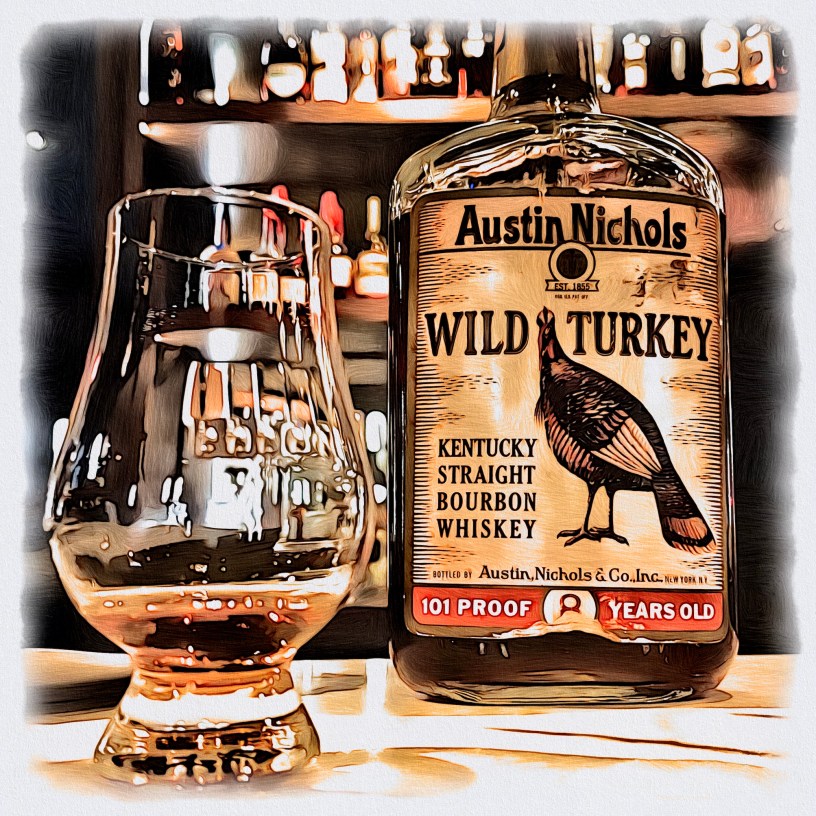
Frank is back with his thoughts on another Wild Turkey rarity. This time it’s a New York, NY bottling of Wild Turkey 101 (likely one of the last with that label). Enjoy! dj
Ask a Wild Turkey nut (is there an à la mode moniker for us folks?) about certain significant time periods in the brand’s history and watch out! Some periods are remembered wistfully, like 1999 when 12-year Wild Turkey 101 bourbon was discontinued in the domestic market. Other years call for celebration, like 1967, when Jimmy Russell was promoted to Master Distiller at J. T. S. Brown & Sons. Then there are those more esoteric periods, dates that really only ring a bell for the most dialed-in members of the Turkey tribe. I’m thinking here about the year 1972.
Before we get to 1972, let’s first consider James Cassidy Russell’s promotion to Master Distiller in 1967. Reputed by that time for helping to elevate the quality standards at what was then the J. T. S. Brown & Sons Distillery, I wonder if Jimmy knew how much of an impact he would soon have on the whiskey world. If he wasn’t yet concerned with the wider world, he surely was a catalyst for the changes that were afoot in Lawrenceburg, KY. A mere four years after receiving his new title, Austin, Nichols & Co. purchased the distillery, renaming it the Wild Turkey Distillery in 1971. The following year, Wild Turkey’s labels transitioned from “New York, NY” to “Lawrenceburg, KY.”
What’s significant about that location change? Well, Wild Turkey for much of its history was a brand that relied on sourced whiskey. We call that an NDP, or non-distiller producer, today. Brooklyn, and later New York, was proudly displayed on Wild Turkey bottles as that’s where grocer Austin, Nichols & Co. was based. Sure, they were buying up barrels from Kentucky, as well as Maryland and Pennsylvania, but for all intents and purposes Austin, Nichols & Co. was a New York brand dating back to 1855. According to multiple reports, 1971 and the purchase of the J. T. S. Brown Distillery marked the last year Wild Turkey officially sourced all of their bourbon.
It should be noted that if you ask Eddie Russell, anything bottled prior to 1981 has the potential to contain sourced whiskey. After all, it’s likely there were still plenty of sourced barrels sitting around after the purchase and there was no point in tossing out the baby with the bathwater. So while the post-1971 label transition doesn’t work as a clean line of demarcation separating sourced Wild Turkey from self-produced Wild Turkey, it still represents the end of an era – albeit one that may have lasted at least another decade.
Should you find yourself at one of Kentucky’s many bars offering vintage spirits you may be keen to try a little esoteric whiskey from yesteryear. That’s precisely the spot I found myself in when I visited a recent arrival to the downtown Louisville bar scene, Seven Cocktails + Bourbon. Seeing either Brooklyn or New York on a bottle of Wild Turkey is always a fun little quirk, as it has the potential to contain sourced whiskey. When I saw just such a bottle tucked away on the top corner of the bar’s shelf I knew that I had to give it a try. When, in my excitement, I shared a photo with David Jennings he responded with a simple two-word directive: “Take notes!” I did as I was told. Today, I have the pleasure of sharing those notes and this historical oddity with you.
Wild Turkey 101 (1972)
Kentucky Straight Bourbon Whiskey
Proof: 101
Age: 8 years
Misc.: bottled by Austin, Nichols & Co., Inc., New York, NY
Tasted neat in a Glencairn after a few minutes rest …
Color: Amber with auburn glints
Nose: There’s some dustiness up front. Stale orange peels, maraschino cherry, butterscotch Krimpets, freshly cracked black pepper, petrichor or more specifically damp oak, dark chocolate, and a beguiling hint of tropical fruit.
Taste: Slightly austere to start before flavor begins seeping into your palate. Tart cherry, butterscotch pastries, dark chocolate-drizzled walnuts, leather, damp oak, vanilla pod, Canadian maple syrup.
Finish: Medium-long w/ leather, more walnuts, black cherry, and nutmeg.
Overall: The dark, rich color and robust aromas from this pour set the stage for a tasting experience that’s more subtle than one might expect. After the first sip I was forced to re-calibrate my expectations and remind myself that this is 101-proof whiskey. While it began a bit lean, bordering on being thin with regards to the mouthfeel, it ultimately revealed itself to simply be delicate.
The hallmarks of well-aged whiskey are on full display with day-old orange peels, walnuts, and a slightly dusty aspect helping to define both the aromas and the flavors on the palate. The finish is where this is arguably most evident, as it delicately undulates out of existence with rich hints of black cherry and leather that refuse to release their grip.
All said and done, this was a dusty Turkey that didn’t reveal any surprises despite its unknown origin. And that’s fine. Rather than lamenting what it isn’t – some unrecognizable and undeniably awesome offshoot of vintage Wild Turkey – it’s worth appreciating that this is a well-made and somewhat recognizable expression. Indeed, it very well may have been made with the help of Jimmy Russell himself before J. T. S. Brown & Sons became the Wild Turkey Distillery. And if there’s one thing Jimmy Russell prides himself on it’s the consistency of Wild Turkey’s mainstays over the years.
Whether Jimmy had a hand in crafting this one or not, it certainly lives up to his exacting standards.
Rating: 4/5 🦃
fd
Photo by Frank Dobbins.

Enjoy this blog? Please consider supporting it via Patreon. In return you’ll receive access to exclusive rewards and weekly whiskey content. Thank you! dj
Ha! I remember our phone conversation when you had discovered that bottle sitting on the shelf at Seven! Love the history lesson tied into this review and learning about Wild Turkey. The question that begs an answer; if ‘82 started the year of Wild Turkey using their own distillate, is that the precursor of what brought forth the raved 8-Year exports in the late 80s, early 90s?